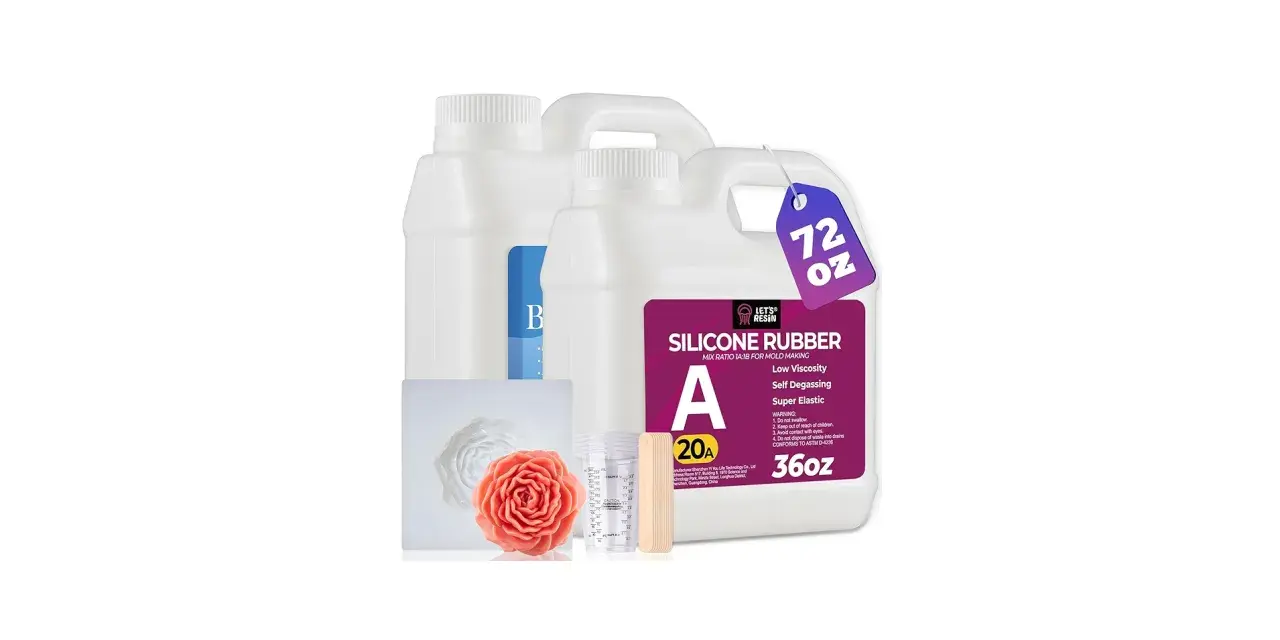
Learning how to make silicone molds is mostly about controlling a few variables: the condition of the master, the mold design, and the cure cycle. I am going to walk through the materials, the mold styles that actually work, and the steps I trust when I want clean detail without wasting silicone. I will also show where silicone fits in thermoforming and molding work, because that decision changes the whole workflow.
The essentials at a glance
- Simple parts usually do best with a one-piece pour mold.
- Platinum-cure silicone gives excellent detail and lower shrinkage, while tin-cure options are often cheaper and a bit more forgiving.
- Seal porous masters, measure accurately, and pour slowly into one corner to reduce bubbles.
- Two-piece and brush-on molds solve undercuts, large shapes, and awkward geometry better than a simple pour mold.
- Silicone is a support tool in most thermoforming workflows, not the final high-heat forming surface.
Where silicone fits in a plastics shop
In a plastics shop, silicone earns its place when I need flexibility, detail, and easy demolding. It is ideal for prototypes, short production runs, trim pieces, texture capture, and parts with undercuts that would fight a rigid tool. That makes it useful for everything from resin casting to copying a thermoformed prototype before committing to expensive tooling.
The key limitation is heat and rigidity. For true thermoforming, the final forming tool is usually rigid wood, composite, or metal, because sheet plastic needs a stable surface under heat and vacuum. Silicone is better as the bridge: it can capture detail from a master, help you iterate fast, and support low-volume molding work before you move into harder tooling.
That makes the next decision simple: choose the silicone and mold style around the geometry, not around habit.
Choose the right silicone and mold style
I start by matching the chemistry to the master and the use case. A wrong choice here usually costs more time than any later step.
Pick the cure chemistry
| Silicone type | Best for | Tradeoff |
|---|---|---|
| Tin-cure | Lower-cost molds, general-purpose casting, workflows that need a little more forgiveness | Usually more shrinkage and shorter library life |
| Platinum-cure | High detail, repeat use, low shrinkage, accurate long-term mold work | Usually more expensive and more sensitive to contamination |
Library life matters more than many beginners expect. It is simply how long the cured mold keeps its shape and detail before it starts to age, distort, or lose accuracy. If I expect repeated casts, I lean toward platinum-cure unless the master or the budget pushes me the other way.
Read Also: Thermoforming Explained - Design Better Plastic Parts
Match the mold style to the part
| Mold style | Use it when | Why it works |
|---|---|---|
| One-piece pour mold | The part is simple and has no major undercuts | Fastest to make and easiest to pour |
| Two-piece mold | The part locks in from both sides or needs a controlled seam | Lets you separate the mold without tearing detail |
| Brush-on mold with support shell | The original is large, vertical, or difficult to box | Saves material and prevents the silicone skin from sagging |
I also pay close attention to compatibility. Some clays, uncured resins, sulfur-bearing materials, and even some 3D prints can interfere with platinum-cure silicone. If a master looks questionable, I test a small patch first. That tiny check is a lot cheaper than scrapping a full pour, and it leads directly into the setup work that prevents most failures.
The setup that saves detail and cleanup
The best molds start before the silicone is mixed. I want the workspace clean, level, and organized so I can focus on the pour instead of chasing leaks and bubbles.
- Master model - clean, fully dry, and free of dust, grease, or uncured residue.
- Mold box - sealed tight enough that the silicone cannot escape through corners or seams.
- Release agent - used when the master needs it, especially with porous or tricky surfaces.
- Sealer - useful on wood, plaster, foam, and other porous originals that would otherwise drink silicone or trap bubbles.
- Mixing tools - cups, stir sticks, and either a scale or calibrated volume cups, depending on the product.
- Protection - nitrile gloves and eye protection, plus ventilation if the room is tight or the product instructions call for it.
For simple pour molds, I usually leave about 1/2 to 1 inch of silicone above the highest point of the master. Thin skins tear more easily, and that margin gives the mold real strength without using absurd amounts of material. If I have vacuum degassing equipment, I use it when the material or the geometry makes trapped air likely, but many low-viscosity silicones still pour well without it.
Once the setup is sound, the actual pour becomes much easier and the cure cycle is far less stressful.
Build a one-piece mold step by step
When the geometry allows it, this is the cleanest and fastest path. I like it because the process is simple enough for a first project but still disciplined enough to produce professional detail.
- Prepare the master. Clean it, dry it, and seal it if it is porous. A barrier coat or compatible sealer is often worth the extra minute.
- Build the mold box. Leave enough space around the master for the silicone wall and the top layer. About 1/2 to 1 inch of clearance is a practical starting point for small parts.
- Secure the original. Hot glue, clay, or double-sided tape can keep the part from floating or shifting once the silicone starts flowing.
- Apply release only when needed. If the product and the master require it, use a release made for mold work. Do not assume every spray can in the shop is suitable.
- Measure accurately. Many hobby silicones mix 1:1 by volume, but plenty do not. I never guess here; I follow the product instructions and mix thoroughly, scraping the sides and bottom of the cup.
- Pour in a thin stream. I pour into one corner and let the silicone rise over the master. That slow stream breaks bubbles and preserves surface detail better than a dump-and-pray pour.
- Let it cure fully. Fast systems can be ready in roughly 30 minutes, while slower systems may need around 24 hours at room temperature. I wait for full cure, not just surface set, because early demolding is one of the easiest ways to damage detail.
- Demold gently. Flex the mold, peel it away from the master, and trim any flash only after the rubber has stabilized.
If the first cast looks clean, I immediately note the mix ratio, room temperature, and cure time. Those details matter the second time around, especially when I need repeatability rather than just a single successful pull.
When a two-piece or brush-on mold makes more sense
Not every part is friendly to a one-piece pour mold. Once the geometry starts locking the part in place, I switch to a split mold or a brush-on skin with a rigid support shell. A parting line is simply the seam where the mold opens, and getting that seam under control is the difference between a clean release and a torn casting.
For a two-piece mold, the most important job is registration. Registration keys are the bumps and sockets that make the two halves return to the same position every time. Without them, the halves drift, flash gets worse, and the seam becomes harder to clean.
For larger originals, a brush-on mold is usually the smarter material choice. I can build up a silicone skin in layers, then back it with a mother mold, which is the rigid support shell that keeps the flexible rubber from sagging. That is a better use of material when the part is tall, sculptural, or too large for a deep pour.
As a rule, I use pour molds for simplicity, two-piece molds for control, and brush-on molds for size or awkward geometry. That practical split keeps the workflow honest and leads straight into the mistakes that most often waste material.
Common mistakes that waste silicone and detail
- Skipping surface prep - dust, grease, and moisture print into the mold and show up on every cast.
- Ignoring cure inhibition - sulfur clay, uncured resin, and some 3D print surfaces can stop platinum-cure silicone from setting properly.
- Mixing too aggressively - fast stirring traps bubbles and leaves voids in fine detail.
- Pulling the mold too early - the rubber may feel set on the surface but still be weak inside.
- Using the wrong release - a generic spray can help, do nothing, or create new problems depending on the materials involved.
- Underbuilding the mold walls - thin silicone flexes too much and tears sooner than it should.
- Assuming every silicone is food-safe or skin-safe - that depends on the specific product, full cure, and manufacturer guidance.
A small test patch solves more of these problems than wishful thinking ever will. I especially test anything unusual: old prototype resin, unknown clay, a freshly printed part, or a master that has been painted or sealed by someone else. That caution is even more important when the mold is part of a broader thermoforming or tooling workflow.
Using silicone alongside thermoforming work
Silicone is not usually the final answer for a high-heat forming tool, but it is very useful around the edges of the process. If I am refining a thermoformed prototype, I may use silicone to capture texture, preserve a shape, or make a repeatable casting before I spend money on a rigid production tool. For short runs, that can be a very efficient bridge between concept and tooling.
| What you need | Silicone's role | What usually works better for the final tool |
|---|---|---|
| Detail capture from a prototype | Flexible mold that records texture and geometry well | Rigid tool once the design is frozen |
| Short-run casting with undercuts | Easy release and good reproduction | Hard tooling when the volume rises |
| Repeated thermoforming under heat | Usually only as a support or intermediate stage | Aluminum, composite, or other rigid tooling |
That is the part people miss: silicone does not compete with every other process. It sits in the workflow where flexibility, detail, and speed matter more than raw heat resistance or production durability. Used that way, it saves time and preserves options.
What I would do first on a new project
If I were starting a fresh mold project, I would keep the first version simple. One clean master, one compatible silicone, one mold line, and one test cast tells me almost everything I need to know without burning through material.
- Choose the simplest mold style that can actually release the part.
- Seal any porous surface before the pour.
- Mix by the numbers, not by eye.
- Pour slowly and let the silicone do the work.
- Wait for full cure before demolding or evaluating the result.
From there, I would keep notes on the product, the room temperature, the pot life, and any compatibility issues. That record turns silicone mold making from a one-off craft task into a repeatable fabrication step, which is exactly what you want when the work sits between prototyping, molding, and thermoforming.