Acrylic is still one of the most useful clear plastics, but it stops being the right answer once the part has to survive abuse, heat, or aggressive cleaning. The acrylic disadvantages are most obvious in high-touch, high-temperature, and chemically exposed environments, where scratches, cracking, and stress issues show up faster than people expect. In this article I break down the real limits, the situations where they matter most, and the design choices that reduce the risk without overcomplicating the project.
What matters most when acrylic has to perform in the real world
- Uncoated acrylic scratches and scuffs become visible quickly in high-touch or frequently cleaned applications.
- Standard sheet is rigid and can crack under sharp impact, especially at edges and drilled holes.
- Heat is a real limit: typical extruded sheet sits around 70°C continuous service and 90°C short-time service.
- Some chemicals can stain, swell, craze, weaken, or even dissolve the sheet.
- Cold bending, tight radii, and poor cooling can build internal stress that fails later.
- Coatings, stress relief, and better detailing help, but they do not remove every limitation.
Where acrylic's limits show up first
Acrylic works best when the design values clarity, UV stability, and a clean finish more than raw abuse resistance. Once the application becomes public-facing, frequently cleaned, or mechanically exposed, the weaknesses stop being theoretical and become part of the maintenance budget.
In practice, I watch for four warning signs: the part gets touched all day, it sits near heat sources, it meets cleaners or solvents, or it has to be bent and installed under stress. Those conditions are where PMMA stops behaving like a simple transparent panel and starts acting like a material that needs careful handling. The next sections break down the biggest failure modes one by one.
Surface scratches are the most visible drawback
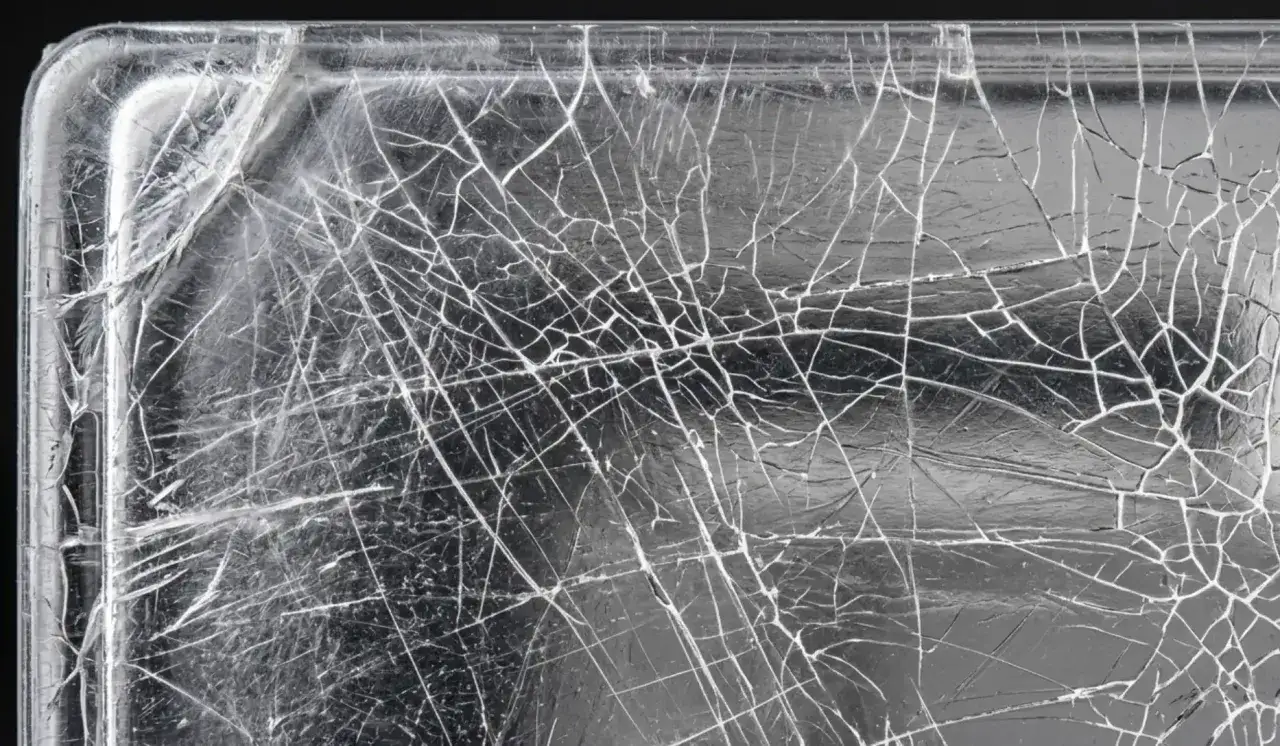
Acrylic is not scratch-proof. Dust, grit, paper edges, and repeated wiping all leave micro-scratches that cloud the surface over time, and small flaws can become more obvious after thermoforming, the process of heating the sheet and forming it over a mold.
That is why I do not treat surface quality as a cosmetic issue only. In a retail display, menu board, light lens, or clear guard, scratches change the whole reading of the part: the surface looks older, the optical clarity drops, and the material can seem lower-end than it really is.
| Surface choice | What it gives you | Practical trade-off |
|---|---|---|
| Uncoated acrylic | Best clarity and simplest fabrication | Scratches and scuffs still build up in high-touch use |
| Hard-coated acrylic | Better abrasion, stain, and solvent resistance | More expensive and less repair-friendly |
| Polycarbonate | Better impact tolerance | Usually needs a coating if appearance retention is important |
Impact is the second problem many teams underestimate
Acrylic is rigid, and that stiffness is useful until the load changes from steady pressure to a sharp hit. Compared with tougher transparent plastics, PMMA is more brittle, so it tends to crack rather than deform when the impact is concentrated at an edge, a drilled hole, or a thin section.
That matters in guard panels, machine covers, protective screens, and public barriers. A light bump is usually fine; a dropped tool, a thrown object, or a repeated vibration point is where the failure risk rises. Typical general-purpose extruded sheet shows notched impact resistance around 1.5 to 2 kJ/m², which is a reminder that acrylic is not the material I would pick for abuse-first environments. Impact-modified grades help, but they improve the margin rather than turning acrylic into polycarbonate.
My rule is simple: if the part must survive vandalism, rough handling, or repeated knocks, I start with a tougher material and come back to acrylic only if clarity or weathering makes the trade worthwhile. That trade-off becomes even tighter once heat enters the picture.
Heat and fire limits narrow the use cases
Acrylic does not behave well when the service temperature climbs. Typical extruded-sheet data puts maximum continuous service temperature at about 70°C and short-time service temperature at about 90°C, with heat deflection temperature, the point where a loaded part starts to sag, around 95°C and Vicat softening around 105°C. Those numbers are not a problem in every project, but they matter near lamps, enclosed fixtures, warm machinery, vehicle interiors, and sun-exposed assemblies with poor ventilation.
Fire behavior is the other part of the story. PMMA is combustible and will burn if ignited; standard sheet is commonly listed as UL94 HB, a basic horizontal burn rating. That does not make it unusable, but it does mean I would not assume acrylic is acceptable in any application with strict fire performance requirements.
When the heat load is real, not imagined, acrylic should be selected only after the full thermal environment is mapped. Otherwise the part can start softening, warping, or losing fit long before anyone notices a problem.
Chemicals, cleaners, and stress cracking can ruin a good part fast
This is the failure mode that surprises people most because the damage is often invisible at first. Acrylic can resist many common conditions well, but some substances can cause staining, swelling, crazing, weakening, or even complete dissolving of the material. The danger increases when the sheet is already under stress from forming, drilling, cold bending, or poor installation.
That combination is called environmental stress cracking, or ESC. In plain language, the plastic is already strained, then a chemical attack helps tiny cracks spread. I see this most often around fasteners, tight bends, solvent-based adhesives, and cleaning habits borrowed from glass care rather than acrylic care.
- Avoid assuming that a product safe for glass is safe for acrylic.
- Check compatibility for adhesives, sealants, inks, and cleaners before production.
- Relieve internal stress when fabrication has introduced it.
- Do not leave cold-bent sheet under constant stress if chemicals may be present.
Once stress and chemistry are both in play, the conversation shifts from everyday care to fabrication discipline, which is where many projects either succeed quietly or fail later.
Fabrication choices can create the very problems you want to avoid
Acrylic is workable, but it is not forgiving when geometry is pushed too hard. Typical fabrication guidance uses a minimum recommended cold-bend radius of 300 times the sheet thickness, which means a 2 mm sheet needs about a 600 mm radius, and a 3 mm sheet needs about 900 mm. Tight bends are not just difficult; they leave permanent stress in the part.
That stress matters because it raises the chance of cracking, cloudiness, and later ESC. Cast PMMA sheets may shrink up to 2% in each direction, while extruded sheet shrinks more in the machine direction, the direction the sheet was extruded. If the final dimensions are critical, I would build that shrinkage into the tool or the part design instead of hoping the sheet behaves like a stable rigid panel.
There is one more trap here. Small scratches and indentations can amplify during forming, so poor handling before thermoforming often becomes a visible quality problem afterward. The practical lesson is straightforward: the way acrylic is cut, stored, bent, cooled, and installed has a direct effect on how long it lasts. That brings us to the decision point most readers really need.
When I would still choose acrylic and when I would not
I still reach for acrylic when the job needs optical clarity, weather exposure, and a polished look, especially in signage, decorative glazing, display work, and light diffusion. The material is often the right answer when the downside is mostly cosmetic and the load is controlled.
I would move away from acrylic when the application is defined by impact, heat, repeated cleaning, or chemical exposure. In those cases, the material choice should follow the risk, not the budget or the sample board.| Project condition | My choice | Reason |
|---|---|---|
| Retail display, light box, sign face | Acrylic | Clarity and finish usually matter more than impact |
| Safety guard or public barrier with frequent contact | Hard-coated acrylic or polycarbonate | Wear and abuse quickly become visible |
| Hot enclosure or near-lamp component | Heat-rated alternative | Standard acrylic softens too early |
| Solvent-heavy or chemically aggressive area | Tested alternative or coated sheet | ESC risk can make the part fail unexpectedly |
| Low-stress decorative panel with UV exposure | Acrylic | Good balance of clarity and weathering |
The right conclusion is not that acrylic is a bad plastic. It is that its disadvantages are concentrated, predictable, and manageable if you design around them instead of discovering them after installation.
Design around the weak points before the part ships
The cleanest way to avoid acrylic failures is to treat the material as a precision finish, not a universal structural plastic. If you protect the surface, limit impact, respect heat, and control stress during fabrication, acrylic performs well in the applications where it is strongest.
My short checklist is simple: choose the grade intentionally, specify the cleaning chemistry, keep bend radii generous, allow for thermal movement, and switch materials when the environment is hostile rather than trying to force one sheet to solve every problem. That is usually the difference between a part that looks excellent for years and one that starts aging after the first season.