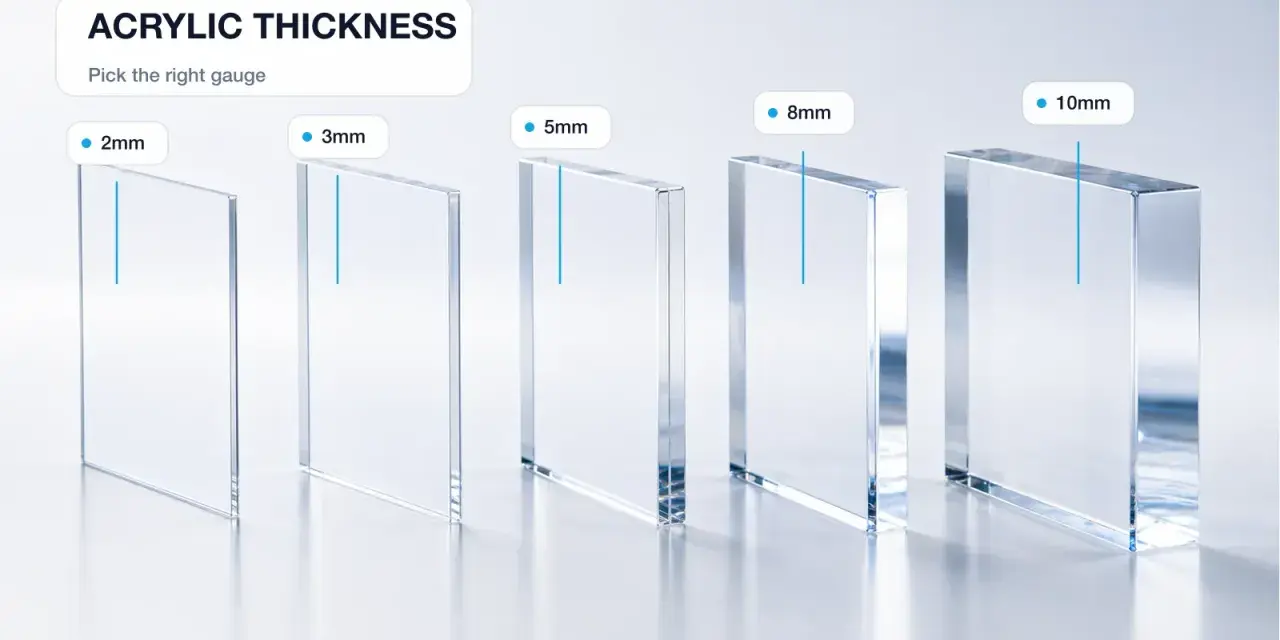
Choosing the right plexiglass thickness for windows is mostly a question of span, exposure, and how much movement the frame can tolerate. I treat acrylic glazing as a structural decision, not just a size choice, because a panel that looks fine on the bench can bow, chatter, or crack once it is framed and exposed. In practice, I start with the opening size, then check whether the window is sheltered, wind-facing, or part of a code-sensitive installation.
The thickness range I would start with on most window jobs
- Use 1/8 inch for small, sheltered openings where flex is minimal.
- Use 3/16 inch for many residential inserts and medium-sized panes.
- Use 1/4 inch when the opening is larger, more exposed, or needs better stiffness.
- Use 3/8 inch for bigger spans or wind-facing panels where bowing matters.
- Leave expansion room and support the panel properly; thickness alone will not prevent cracking.
The quickest rule I use before I touch the frame
If the opening is small and well supported, I am comfortable starting at 1/8 inch. For most custom window inserts, 3/16 inch is the first thickness that feels balanced: it is still easy to cut and drill, but it behaves much better than 1/8 inch once the sheet gets larger. For exterior work, I usually move to 1/4 inch unless the opening is truly modest and protected from wind.
My practical shortcut is simple: small and sheltered, stay thin; larger or exposed, step up. Once I get into wide openings, visible deflection becomes the real issue, not just breakage. That is where the frame, the fasteners, and the support layout start mattering as much as the sheet itself, which is why I always check the geometry next.

How span and wind exposure change the thickness you need
ACRYLITE's glazing guidance is a useful benchmark because it ties thickness to panel area and outdoor exposure instead of pretending one sheet works for everything. Their size-based outdoor chart points toward 1/8 inch for small panels, 3/16 inch for medium openings, 1/4 inch for larger ones, and 3/8 inch once the panel gets broad enough that deflection becomes hard to ignore.
| Window area | Good starting thickness | What that usually means in practice |
|---|---|---|
| 1-5 sq. ft. | 1/8 in. (3 mm) | Small inserts, cabinet-style windows, or sheltered openings with limited load |
| 6-15 sq. ft. | 3/16 in. (4.5 mm) | Most residential replacement inserts and medium panes |
| 15-32 sq. ft. | 1/4 in. (6 mm) | Exterior glazing where stiffness matters and the panel starts to span more noticeably |
| 32.5 sq. ft. and up | 3/8 in. (9.5 mm) | Larger exposed openings, windbreaks, and panels where bowing becomes obvious |
Two geometry rules save a lot of mistakes. First, larger widths generally deserve the next thicker sheet. Second, long narrow openings can sometimes use the next thinner thickness, but only when the frame fully supports the panel and the wind load is modest. I also keep in mind that these recommendations are for vertically installed windows, so sloped or overhead glazing needs a separate check.
What each thickness is good at
When I break the decision down by thickness instead of by square footage, the tradeoffs get easier to read. The right choice is not only about resisting breakage; it is also about controlling flex, keeping the optical line clean, and avoiding stress around fasteners and edges.
| Thickness | Best use | Main limitation |
|---|---|---|
| 1/8 in. (3 mm) | Small interior panels, light-duty inserts, sheltered windows | Bows quickly on larger spans and feels flimsy in exposed locations |
| 3/16 in. (4.5 mm) | Many residential window inserts and moderate-size openings | Still needs good support if wind or temperature swings are significant |
| 1/4 in. (6 mm) | Exterior windows, patio enclosures, wider panes, better stiffness overall | Costs more, weighs more, and needs more careful clearance planning |
| 3/8 in. (9.5 mm) | Large exposed openings, windbreaks, and panels where visible deflection must be minimized | Harder to fabricate and usually more than a normal window really needs |
I rarely jump straight to 1/2 inch for a normal window. By that point, the project is usually telling me that either the span is too ambitious, the frame is too open, or a different glazing system would serve the job better. Acrylic works well, but it still has practical limits.
Acrylic compared with glass and polycarbonate
Thickness is only part of the decision. I also look at what the panel has to survive, because acrylic is not the same answer as glass or polycarbonate. Acrylic gives you excellent clarity, easier fabrication, and a cleaner look than many people expect, but it is not the most impact-resistant option.
| Material | What it does well | Where it falls short | Best fit |
|---|---|---|---|
| Acrylic | High clarity, easy cutting and drilling, good weathering, decent scratch resistance | Can flex on larger spans and is not the toughest option against hard impact | Custom window inserts, decorative glazing, storm panels, general clear sheet use |
| Glass | Excellent surface hardness and familiar appearance | Heavier, more brittle, and less forgiving when impact is the concern | Standard architectural glazing where the frame and code are already built around glass |
| Polycarbonate | Best impact resistance, strong choice for abuse-prone locations | Scratches more easily and usually does not have the same crisp surface feel as acrylic | Security glazing, high-impact environments, storm-prone applications |
If impact is the main concern, polycarbonate often deserves a hard look. If the priority is clear optics, easier fabrication, and a window that still looks polished after installation, acrylic usually has the edge. Glass still belongs in plenty of projects, but for custom plastic glazing, acrylic is the material I reach for when I want a cleaner balance of clarity and workability.
Installation details that protect the panel from cracking
Even the right thickness can fail early if the installation traps stress. Acrylic expands and contracts more than glass, so I leave room for movement, keep the edges clean, and avoid forcing the sheet into a frame that is too tight. The fit should support the panel, not preload it.
| Opening size | Mid-temperature cutback from frame size | Why it matters |
|---|---|---|
| Up to 36 in. | 1/16 in. | Enough room for movement without making the panel sloppy |
| 36-65 in. | 1/8 in. | Helps the sheet move as temperatures change |
| 65-90 in. | 3/16 in. | Reduces stress on larger panels |
| 90-117 in. | 1/4 in. | Important when seasonal expansion starts to add up |
| 117-144 in. | 5/16 in. | Prevents binding on large-format glazing |
I also drill oversized holes, never countersink fasteners into the sheet, and keep the edges smooth so cracks do not start at a rough cut. Where possible, I like full edge support on all four sides, because acrylic performs better when the load is spread evenly instead of concentrated at a few points. If the window is in a location that triggers U.S. safety-glazing rules, I verify that the specific product is approved for that use before I order it.
The mistakes that cause early failure
Most bad acrylic window installs fail for boring reasons, not exotic ones. The sheet was too thin, the opening was too ambitious, or the installer treated acrylic like a rigid glass substitute and ignored movement.
- Choosing thickness by appearance instead of by span and exposure.
- Using 1/8 inch on a window that really needs 3/16 or 1/4 inch.
- Skipping expansion clearance because the panel seemed to fit tightly.
- Over-tightening screws or using countersunk fasteners that create stress points.
- Assuming any clear sheet is acceptable in a location that requires certified safety glazing.
- Using acrylic where polycarbonate would handle impact much better.
When those mistakes stack up, the failure usually starts as a small crack at a hole or edge, then spreads after a few temperature swings. That is why I keep repeating the same principle: thickness helps, but the frame and fastening method decide whether that thickness can actually do its job.
The spec I would write before ordering the first sheet
If I were specifying a typical residential acrylic window today, I would start with 3/16 inch for smaller inserts and move to 1/4 inch as soon as the opening gets wider or more exposed. For large wind-facing panels, I would step up again to 3/8 inch rather than hoping a thinner sheet will behave well in a stronger frame. I would also make sure the sheet is UV-stable, cut with proper expansion clearance, and installed with oversize holes and smooth edges.
That is the practical formula I trust: start with span, check exposure, support the sheet properly, and only then fine-tune thickness. If the location is code-sensitive, I would treat approval status as part of the material choice, not an afterthought, because the safest acrylic window is the one that fits both the structure and the rules around it.